The Hidden Mechanics of Recommendation Engines in Multilingual Entertainment Libraries
Written by Noah Hartmann · Aug 20, 2026
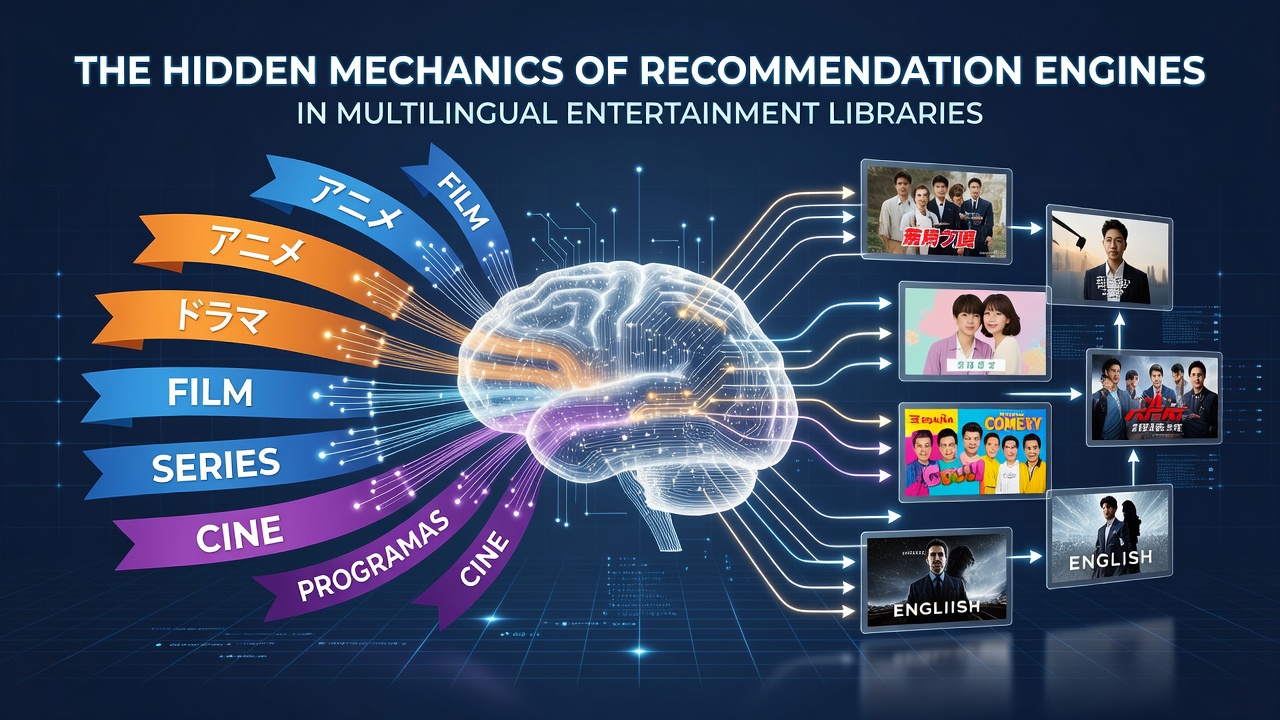
The Hidden Mechanics of Recommendation Engines in Multilingual Entertainment Libraries
Recommendation engines in multilingual entertainment libraries process vast datasets that span user viewing histories, subtitle preferences, and regional content availability, all while balancing accuracy across languages that differ in syntax, idioms, and cultural context. These systems combine collaborative filtering with content-based analysis and hybrid models to surface relevant titles from libraries containing English, Spanish, Hindi, Mandarin, and dozens of other languages. Data from major platforms shows that users who engage with content in their primary language plus one secondary language receive recommendations that incorporate cross-lingual signals at rates exceeding 40 percent in recent analyses.
Core Algorithm Components
Collaborative filtering identifies patterns among users who share similar watch times and ratings, yet it must account for language barriers that fragment user groups into smaller cohorts. Content-based methods examine metadata such as genre tags, cast information, and plot summaries that undergo machine translation before embedding into vector spaces. Hybrid approaches merge these techniques so that a viewer in Canada who finishes a Tamil-language thriller might receive suggestions for similar Korean dramas rather than defaulting to English-only options. Researchers at institutions across North America and Europe have documented how matrix factorization techniques adjust weights dynamically when language metadata changes, which occurs frequently as platforms add dubbed or subtitled versions throughout the year.
Embedding models trained on multilingual corpora map words and phrases from different languages into shared semantic spaces, allowing the engine to recognize that a suspenseful narrative in French shares structural elements with one in Japanese. Natural language processing pipelines extract entities, sentiment scores, and thematic keywords before feeding them into ranking layers that prioritize titles based on predicted engagement metrics. As of August 2026, several services updated their embedding models to include real-time feedback loops from viewer completion rates segmented by primary audio track and subtitle language pair.
Handling Linguistic and Cultural Variables
Language detection occurs at multiple points, starting with account settings and extending through playback data that tracks whether users switch audio tracks or enable subtitles. Recommendation engines apply separate weighting factors for dubbed audio versus original language with subtitles, since completion rates vary significantly across these formats according to internal platform reports. Cultural adaptation layers adjust for regional sensitivities by filtering or re-ranking content that carries different age ratings or thematic elements in one market versus another. Observers note that these adjustments rely on localized regulatory inputs and viewer-reported flags rather than purely algorithmic decisions.
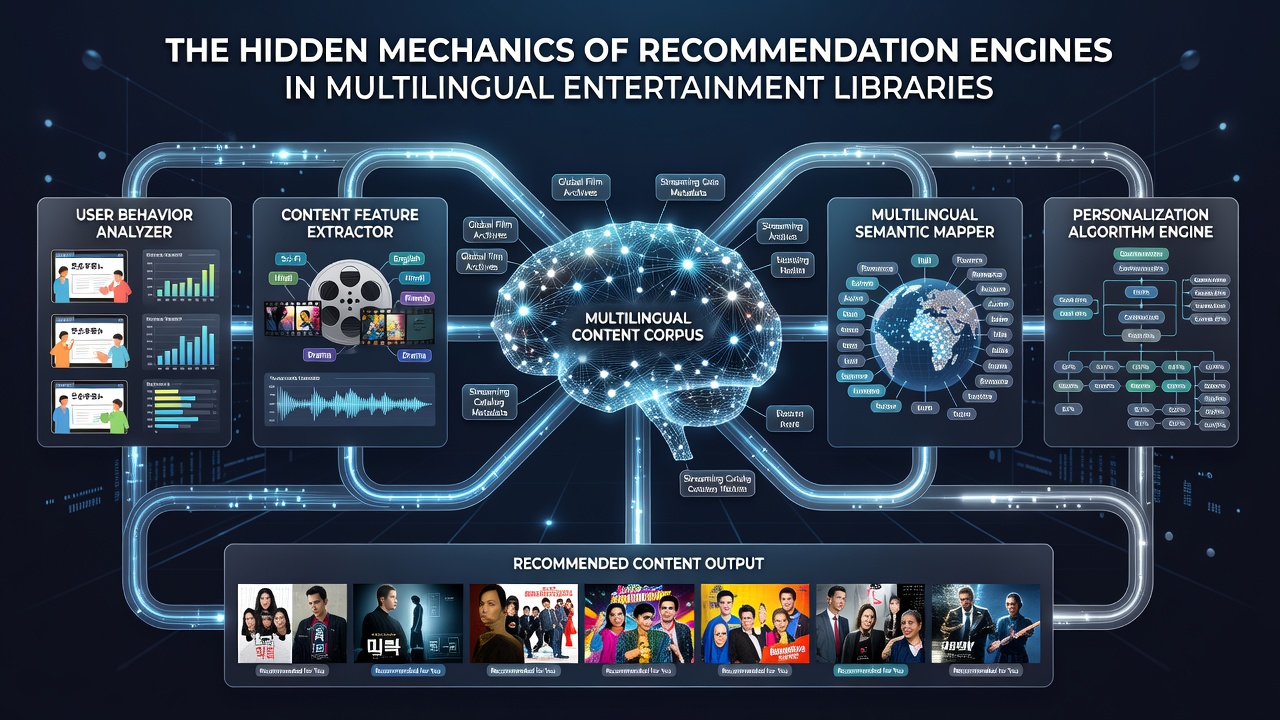
Session-based recommendations capture short-term shifts, such as when a user explores a new language during travel or language-learning periods, and these signals feed into temporary profile adjustments that reset after a defined interval. Long-term profiles maintain stable language preferences while incorporating gradual expansions, for example when consistent viewing of Portuguese-language series begins influencing broader recommendations. Studies conducted by academic groups in Australia and the European Union indicate that incorporating explicit language preference toggles reduces unwanted suggestions by measurable margins compared to implicit detection alone.
Data Infrastructure and Privacy Considerations
Storage architectures separate language-specific metadata from behavioral logs to comply with regional data protection rules, while still allowing aggregated analysis for model training. Anonymized viewing sequences from users in multiple countries train shared layers of the neural networks, whereas personalized ranking occurs on-device or in region-specific servers. A report from the Canadian Centre for Cyber Security highlights how multilingual systems require additional safeguards against cross-border data transfers that could expose viewing patterns tied to linguistic minorities. Platforms maintain audit trails that document when language models receive updates, particularly after new content libraries launch in previously unsupported languages.
Real-time serving infrastructure balances latency requirements with the computational cost of running multiple language models in parallel. Edge caching stores pre-computed recommendation lists for high-traffic language combinations, while less common pairs trigger on-demand inference that pulls fresh embeddings. Industry data compiled through trade associations in Asia and Latin America shows average response times under 200 milliseconds even when queries involve three or more languages in a single session.
Evaluation Metrics Across Languages
Standard metrics such as precision at k and normalized discounted cumulative gain receive language-stratified breakdowns so developers can identify underperforming cohorts. A/B testing frameworks isolate the impact of new multilingual features by holding user language distributions constant across control and treatment groups. External benchmarks published through academic channels demonstrate that models incorporating explicit cross-lingual transfer learning outperform monolingual baselines on datasets covering at least ten languages by margins ranging from 8 to 15 percent in ranking quality.
Conclusion
Recommendation engines operating within multilingual entertainment libraries integrate technical components that address both algorithmic efficiency and linguistic diversity. Continuous refinement of embedding spaces, cultural filters, and privacy-preserving data flows shapes how these systems deliver content across global audiences. Updates implemented by mid-2026 reflect ongoing efforts to align model performance with the expanding range of languages and viewing contexts present in modern libraries.